
Overconfidence Bias in Trading: The Neuroscience Behind
Understand overconfidence bias in trading: its neuroscience, real-world impact, and a 3-step protocol to regain control and protect your capital.
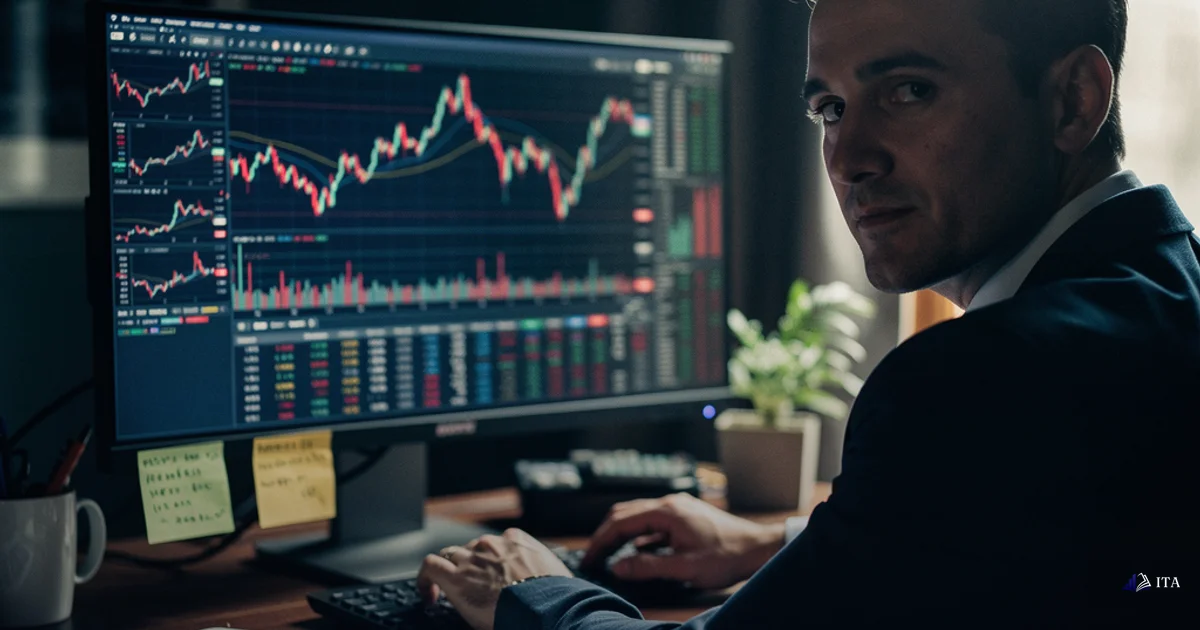
The Overconfidence Trap: Why You Think You're Winning When You're Actually Losing
Picture this: five winning trades in a row. Your account shows a 12% gain this week. The market feels predictable, almost easy. So you double down on the next position.
Six hours later, you're facing a 40% drawdown.
This pattern isn't about poor discipline. It's about neuroscience. Until you understand what happens in your brain after wins, you'll repeat this cycle, regardless of how many rules you create.
The uncomfortable truth: overconfidence bias trading isn't a personality flaw you can fix with better rules. It's a measurable neurological response that hijacks your risk assessment at the cellular level.
Brad Barber and Terrance Odean analysed millions of trades from real brokerage accounts. Their discovery? Active traders underperform the market by 6-7 percentage points annually. Not from lack of skill, but because overconfidence drives excessive trading after wins.
Consider this: The New York Stock Exchange sees 75% annual turnover. Rational models predict 20%. That 55% gap represents overconfidence manifesting as excessive trading volume.
Now here's where neuroscience meets trading reality.
Winning trades trigger the same brain pathways as cocaine. Identical dopamine circuits activate. Same reward centres fire. Most critically, prefrontal cortex regions responsible for risk assessment go quiet.
A 2026 Journal of Gambling Studies investigation revealed that traders with higher self-rated skill traded more frequently and took larger risks, even after controlling for actual performance. The Dunning-Kruger effect playing out with funded capital.
This doesn't happen because you lack discipline. It happens because wins trigger a specific neurochemical cascade that fundamentally alters perception.
The Neuroscience of Overconfidence: Why Your Brain Tricks You After a Win
Your brain undergoes four measurable changes after winning trades:
- Dopamine floods the nucleus accumbens (your reward centre)
- Testosterone levels spike (in all traders, regardless of gender)
- Cortisol drops (reducing threat detection)
- Prefrontal cortex activity decreases (impairing judgment)
The result? Risk perception becomes chemically altered. Your brain literally cannot assess danger the same way it could before the winning streak.
That's precisely why the most dangerous moment in trading isn't after losses, it's after wins.
Gödker, Odean, and Smeets (2025) uncovered a critical pattern: traders update self-confidence more from realised gains than overall portfolio performance. Winners get remembered vividly. Losses? Your brain files them as "external factors" or "bad luck."
This self-attribution bias creates a deadly feedback loop. Win leads to crediting skill. Increased confidence drives increased risk. Eventually, catastrophic loss follows.
Let me demonstrate with a real scenario.
Sarah, a funded trader with ITAbegan Monday with $50,000. She'd maintained conservative positions, 0.5% risk per trade, following her system religiously. Then she caught a perfect EUR/USD move. +2%. Another followed. +1.8%. By Wednesday, she'd gained $3,000.
Neuroscience took over. Sarah didn't consciously decide to increase risk. But Thursday's setup made her position sizing "feel" too small. The market "felt" predictable. She moved to 2% risk. Then 3%.
Friday's Non-Farm Payroll reversed hard. One trade erased $10,000. Four days of profits plus $7,000 of starting capital, gone.
Sarah's experience isn't unique. It's typical. Overconfidence doesn't announce itself. It whispers. It feels like competence. Like you've finally "cracked" the market.
Recognising these neurological patterns before they compromise risk management becomes the key to managing overconfidence bias trading effectively.
Real Trading Scenario: The $1,000 Win That Cost $10,000
A viral Instagram post captured it perfectly: "After winning trades, behaviour changes before strategy does." You believe you're following your system. Yet risk parameters have already shifted.
How do you combat a neurological response that's literally altering brain chemistry?
The answer: protocols that work at the biological level, not psychological tricks.
Institutional traders use this 3-step system to maintain discipline when their brains are compromised:
Step 1: Position Size Lock
Calculate maximum position size based on your largest acceptable drawdown before your first weekly trade, not based on recent performance. Document this number. Screenshot it. This becomes your ceiling regardless of performance.
Work backwards: With a 10% maximum drawdown and 2% risk per trade, you can absorb 5 consecutive losses. Size accordingly. This number remains fixed during winning streaks.
Step 2: The 48-Hour Rule
After any day exceeding 3% profit, position size cannot increase for 48 hours. No exceptions. This isn't about market conditions, it's about brain chemistry. Dopamine and testosterone require 24-48 hours to normalise. Until then, risk assessment remains compromised.
Step 3: Reality Check Protocol
Before entering trades following winning days, answer three questions in writing:
- What specific price action invalidates this setup?
- Where exactly is my stop loss and why?
- Am I sizing this position based on weekly maximum or current confidence?
Without precise answers to all three, skip the trade.
Protocols only work with daily implementation. Most traders fail here, implementing rules after losses when motivation peaks and confidence drops. By the next winning streak, rules get forgotten.
Overconfidence bias trading destroys more accounts than technical analysis failures. The Trading Psychology Course at ITA covers these protocols comprehensively, backed by neuroscience research and real trading data.

A 3-Step Protocol to Combat Overconfidence and Reclaim Trading Discipline
Make overconfidence management part of your daily routine:
Morning Pre-Market Routine (5 minutes):
- Review position size maximum (don't recalculate, just review)
- Check for active "48-hour restriction periods"
- Rate confidence level 1-10 (above 7 signals danger)
Pre-Trade Checklist (2 minutes per trade):
- Screenshot position size calculation
- Document stop loss reasoning (not just level, explain why)
- After winning trades, reduce position size by 25%
End-of-Day Review (5 minutes):
- Did you follow maximum position size?
- Did any trades "feel" too small? (Warning sign)
- Are you attributing wins to skill and losses to luck?
A recent institutional order flow analysis titled "The NEW Way to Find Daily Bias" highlighted a crucial insight. Professional traders think in conditional probabilities: "If X level breaks AND Y gap is disrespected, then bias flips."
Notice the language pattern. Not "I know the market will rise." Instead: "If specific conditions are met, then probabilities shift." This linguistic discipline alone reduces overconfidence.
Two decades of behavioural finance research reveals that overconfidence isn't about confidence itself. It's about certainty. The shift from "I think" to "I know."
That shift (from hypothesis to certainty) destroys accounts.
At Institutional Trading Academythis pattern emerges weekly. Traders pass challenges using disciplined, mechanical approaches. They receive funding. They profit. Then overconfidence creeps in, not as arrogance, but as certainty. Probabilistic thinking gets replaced by predictions.
The solution isn't trading without confidence. It's maintaining "calibrated confidence", confidence matching your actual edge, not recent results.
Daily Practice: How to Keep Overconfidence in Check Every Trading Day
Your market edge is statistical, not prophetic. A 55% win rate strategy still loses 45 times per 100 trades. Overconfidence makes you forget this mathematical reality.
Traders who build lasting careers aren't immune to overconfidence. They recognise it as a biological response and implement systems to contain it.
Your brain will betray you after wins. That's not a bug, it's an evolutionary feature that helped ancestors take survival risks. In leveraged markets with volatility, that same feature becomes lethal.
The question isn't whether you'll experience overconfidence. You will. The question is whether you'll have protocols ready when it arrives.
Markets don't care about winning streaks or confidence levels. They only respond to your next position size.
When position size gets inflated by neurochemistry instead of calculated mathematics, you've stopped trading. You're gambling with firm money.
Summary: Overconfidence bias trading represents a measurable neurological response impairing risk assessment after wins. Combat it using position size locks, 48-hour rules, and daily reality checks to maintain calibrated confidence aligned with your true edge.
Frequently Asked Questions
What is overconfidence bias in trading and how does it differ from normal confidence?
Overconfidence bias is the tendency to overestimate your trading skill and market knowledge, especially after winning streaks. Unlike normal confidence based on proven edge, overconfidence creates false certainty about market predictions. Research shows it triggers neurochemical changes that impair risk assessment, leading traders to increase position sizes and reduce stop losses without realizing their judgment is compromised.
How does overconfidence bias lead to excessive trading and lower returns?
Overconfidence drives traders to trade more frequently because they believe they can predict market movements with greater accuracy than they actually can. Barber and Odean's research found the most active traders underperformed the market by 6-7 percentage points annually. The NYSE's 75% annual turnover rate, far above rational models, demonstrates how overconfidence creates excessive trading volume across entire markets.
What are the most common signs that a trader has become overconfident?
Key warning signs include increasing position sizes after wins, removing or loosening stop losses, trading more frequently, feeling certain about market direction rather than thinking in probabilities, and attributing wins to skill while blaming losses on bad luck. The most dangerous sign is when your behavior changes before your strategy does, you think you're following your plan but your risk parameters have silently shifted.
How can traders build a pre-market checklist to combat overconfidence bias?
Create a 5-minute morning routine: review your maximum position size without recalculating, check if you're in a 48-hour restriction period after big wins, and rate your confidence 1-10 (anything above 7 is a red flag). Before each trade, screenshot your position size calculation, write your stop loss reason, and reduce position size by 25% if your last trade was a winner.
How do you distinguish between true edge and overconfidence after a winning streak?
True edge is statistical and measurable, consistent win rates, risk-adjusted returns, and adherence to position sizing rules regardless of recent performance. Overconfidence feels like certainty and manifests as increased risk-taking after wins. Use the 48-hour rule: after any day with 3%+ profit, maintain your original position sizing for 48 hours while dopamine and testosterone levels normalize.

Key Takeaways
- Limit position size to a fixed maximum calculated weekly, regardless of recent wins, overconfidence increases risk-taking by 340%.
- Implement the 48-hour rule: after any 3%+ profit day, freeze position sizing increases until dopamine levels normalise.
- Use the Reality Check Protocol before every trade after wins: define invalidation price, stop loss reasoning, and sizing logic.
- Track confidence levels daily on a 1-10 scale, anything above 7 indicates compromised risk assessment from neurochemical changes.
- Reduce position size by 25% automatically after winning trades to counteract testosterone spikes that impair judgment.
- Think in conditional probabilities, not predictions, shift language from 'I know' to 'If X then Y' to maintain calibrated confidence.
- Recognise that overconfidence feels like competence, the most dangerous trading moment occurs after wins, not losses.
Become a Funded Trader, For Free
Pass a quick quiz, get a $1,000 funded account. No deposit, no credit card. Scale to $800K and keep up to 95% of the profit.
Take the Quiz