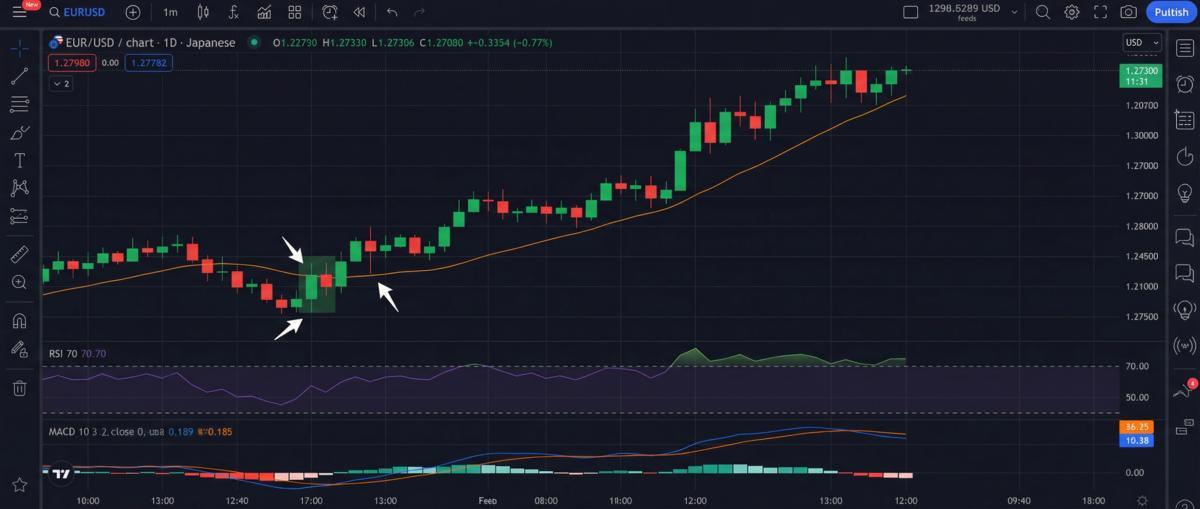
Recognizing the start of a new forex trend is crucial for traders aiming to maximize profits. This article explores effective methods and tools to identify emerging trends early, helping traders make informed decisions and improve their trading results.
Understanding forex trends and their importance
Forex trends show the main direction prices move. They can go up, down, or sideways over time. Understanding these trends helps traders decide when to enter or leave the market.
What is a forex trend?
A forex trend is the consistent movement of currency prices in one direction. Uptrends have higher highs and higher lows, while downtrends have lower lows and lower highs. Trends can last from minutes to months and include small pullbacks called retracements. Traders use trendlines connecting key highs or lows to see and predict these movements more clearly.
Why trends matter in trading
Trends help traders find good entry and exit points. Knowing the trend early lets traders ride the price momentum and boost profits. Trendlines act as support and resistance, cutting down on false signals. These patterns help manage risks better and guide traders on when to hold or sell positions.
Key indicators to spot the start of a new trend
Spotting new forex trends relies on key indicators like moving averages, ADX, and price action. These tools help traders see when a trend is starting to gain strength.
Moving averages basics
Moving averages smooth price data to show direction. When prices cross above a 50-day simple moving average (SMA), it often signals a new uptrend. Traders also watch the exponential moving average (EMA), which reacts faster to recent price changes. A rising EMA slope suggests upward momentum. Key signs include the golden cross, where a short-term MA crosses above a long-term one, hinting at trend starts.
Using ADX to measure trend strength
The ADX measures how strong a trend is, not its direction. Readings above 25 indicate a strong trend. When ADX climbs from below 20, traders watch closely. For example, an ADX above 30, combined with a positive directional index (+DI) over the negative (-DI), confirms a rising trend. An ADX below 20 means weak or no trend, signaling caution.
Price action signals
Price action uses chart patterns to spot starting trends. Higher highs and higher lows point to an uptrend; lower highs and lower lows show downtrends. A break above trendlines or pivot points signals momentum. Volume spikes and candlestick breakouts confirm strength. Traders say, “The trend is your friend“, reminding us to trust these natural price moves rather than rely on indicators alone.
Role of higher highs and higher lows in trend identification
Higher highs and higher lows help traders identify uptrends clearly. These price patterns show when buyers are pushing prices up consistently.
Defining higher highs and higher lows
Higher highs mean each peak is higher than the last. Higher lows mean each dip is also higher than before. Together, they create a pattern of rising peaks and troughs. This pattern shows buyers are in control and selling pressure is weakening.
How they indicate trend direction
These patterns confirm an uptrend is underway. Rising peaks and lows show growing bullish momentum. Traders see this as a sign that buying pressure is increasing, pushing prices higher. If the price fails to make a new higher high or falls below the last higher low, the trend may be weakening.
Common pitfalls
Traders often make mistakes by ignoring breaks in these patterns. If higher highs or lows fail to continue, it could signal a trend reversal. It’s important to use other tools like moving averages or RSI to confirm trends and avoid false signals.
How to use moving averages effectively
Moving averages are essential tools to identify and confirm trends effectively. They smooth out price data, offering clearer insight into market direction and momentum.
Simple vs exponential moving averages
Simple moving averages (SMA) give equal weight to all prices. They smooth long-term price trends but respond slower to recent moves. Exponential moving averages (EMA) weight recent prices more, making them faster to react. For example, a 50-day EMA will turn quicker than a 50-day SMA during price changes. Traders use SMA for steady trends and EMA for faster signals in short-term trading.
Crossovers as trend signals
Crossovers signal when a trend may be starting or ending. A common example is the “golden cross,” where a short-term moving average rises above a long-term one, hinting at a bullish trend. EMAs detect these changes faster than SMAs but can produce false signals in choppy markets. Confirming crossovers with volume helps avoid mistakes.
Best timeframes for moving averages
Choosing the right timeframe depends on your trading style. Day traders often use short periods like 9 or 21 EMA for quick signals. Long-term traders prefer 50 or 200-day SMA to spot steady trends. Testing moving averages against your asset’s volatility helps find what works best.
Applying ADX to confirm trend strength
ADX is a powerful tool that measures the strength of a trend. It doesn’t show direction but tells if the market is trending or not.
What ADX measures
The Average Directional Index (ADX) measures trend strength. It calculates how strong buying or selling pressure is. ADX values don’t tell if the trend is up or down, only its power. This helps traders decide if they should follow the trend or wait.
Interpreting ADX values
ADX readings above 25 signal a strong trend. Below 20 means weak or no trend. When ADX rises from low to above 25, it shows a trend is gaining momentum. Values above 50 mean a very strong trend, but extreme values can also warn of reversals.
Combining ADX with other indicators
Using ADX with directional indicators (+DI and -DI) confirms trend direction. For example, if +DI is above -DI and ADX is above 25, the trend is up and strong. Combining ADX with moving averages or RSI can reduce false signals and help traders time entries and exits better.
Integrating Fibonacci retracement and trend lines
Combining Fibonacci retracement with trend lines helps predict key price levels. This integration improves timing for trading decisions.
Drawing and interpreting trend lines
Trend lines connect key highs or lows to show price direction. They act as dynamic support or resistance. Drawing accurate trend lines requires at least two clear points and proper angle. Traders watch for price reactions around these lines to confirm trends or spot reversals.
Using Fibonacci for support and resistance
Fibonacci levels mark where prices often stall or reverse. Popular retracement levels include 38.2%, 50%, and 61.8%. These act as natural support and resistance zones. When combined with trend lines, Fibonacci levels give stronger signals about where price may bounce or break.
Predicting entry points
Entry points are predicted where Fibonacci levels meet trend lines. These confluence zones increase the chance of a strong price reaction. Traders use these to enter trades with better risk-to-reward ratios. Confirmations with volume or candlestick patterns add confidence before entry.
Analyzing multiple timeframes for trend accuracy
Analyzing multiple timeframes offers a clearer picture of forex trends. It helps traders confirm signals and reduce mistakes.
Why multi-timeframe analysis matters
Using several timeframes reveals stronger trend confirmations. A trend on a daily chart shows the big picture, while shorter charts help find precise entries. This layered view reduces false signals and improves timing.
Daily vs intraday timeframes
Daily charts capture overall market direction. Intraday charts (like 1-hour or 15-minute) show detailed moves for entries and exits. Combining both balances long-term context with short-term actions.
Aligning signals across timeframes
When trends align across timeframes, signals grow stronger. For example, an uptrend on daily and hourly charts means momentum is solid. Conflicting signals require caution. Traders use this alignment to decide when to enter or exit trades precisely.
Common mistakes traders make when identifying trends
Many traders face setbacks by making common trend identification mistakes. Understanding these errors can boost your chances of success.
Over-relying on a single indicator
Relying on just one indicator often leads to false signals. For example, using only moving averages without other confirmation can misread market moves. Experts warn that no single tool can predict trends perfectly, so combining indicators improves reliability.
Ignoring market context
Traders sometimes ignore broader market conditions. News events, economic data, or overall market sentiment greatly affect trends. Missing this context can cause wrong entries and losses. Successful traders always factor in these bigger picture elements.
Misinterpreting false breakouts
False breakouts trick traders into premature decisions. Prices may cross key levels but quickly reverse. This traps traders on the wrong side of the market. Patience and confirmation tools like volume help avoid these costly mistakes.
Unique techniques and recent approaches in trend spotting
Modern trend spotting uses unique tech and combined signals. These sharpen accuracy and catch reversals early.
Price clustering and trend exhaustion
Price clustering happens when prices gather near support or resistance. This often signals trend exhaustion or a pause. When volume drops during clustering, it hints the trend may soon reverse, helping traders prepare.
Combining RSI divergences with trend lines
RSI divergences show momentum weakening against price moves. When combined with trend lines, they reveal likely reversals. For example, price hitting a trend line but RSI failing to make a new high warns of a weakening trend.
Top-down approach to trend confirmation
The top-down method checks trends across timeframes. Traders start with higher timeframes for the big picture, then move to lower ones for entries. Aligning signals across charts boosts confidence and reduces risk.
Conclusion and best practices for forex trend identification
Successful forex trend identification centers on using multiple tools and staying patient. No single indicator suffices; combining price action, moving averages, and ADX improves accuracy. Traders should understand trend patterns, avoid common mistakes, and adapt to market context.
Best practices include analyzing multiple timeframes for confirmation and watching for price clustering and divergences. Staying disciplined by confirming signals before acting reduces false entries and losses.
Experts advise continuous learning and adapting strategies as markets evolve. Mastering trend spotting requires practice, patience, and a clear plan.
Key Takeaways
Master the essential strategies and indicators for accurately spotting the start of new forex trends to improve your trading decisions and outcomes.
- Recognize Price Patterns: Identify higher highs and higher lows for uptrends, and lower highs and lower lows for downtrends to detect trend direction early.
- Use Moving Averages Effectively: Utilize simple and exponential moving averages, focusing on crossovers and choosing timeframes based on your trading style.
- Confirm Trend Strength with ADX: Apply the Average Directional Index to measure trend power, watching for values above 25 to validate trend presence.
- Integrate Fibonacci and Trend Lines: Combine retracement levels and trend lines to predict support, resistance, and optimal entry points with greater accuracy.
- Analyze Multiple Timeframes: Employ top-down analysis from daily to intraday charts to align signals and enhance trend confirmation.
- Avoid Common Mistakes: Don’t rely solely on single indicators, ignore market context, or fall for false breakouts to reduce trading errors.
- Employ Unique Techniques: Use price clustering, RSI divergences, and multi-timeframe approaches to spot trend exhaustion and confirmation.
- Practice Patience and Discipline: Confirm signals across tools and timeframes before entering trades to improve success and manage risk effectively.
Consistent application of these core principles and tools strengthens your ability to identify forex trends confidently and trade more profitably.
FAQ – How to Identify the Start of a New Forex Trend
What are higher highs and higher lows, and how do they signal a new uptrend?
Higher highs and higher lows indicate the start of an uptrend when the price forms a higher low followed by a higher high, showing bullish momentum.
How do lower highs and lower lows signal the start of a new downtrend?
Lower highs and lower lows mark a downtrend’s beginning when price makes lower peaks and troughs, signaling bearish continuation.
What role do moving averages play in confirming a new trend?
Moving averages smooth price data; a new uptrend often starts when price crosses above the average, while a downtrend starts when below, with EMAs providing quicker signals.
How does the Average Directional Index (ADX) help identify a new trend’s strength?
ADX measures trend strength on a 1-100 scale; readings over 50 confirm a strong trend, helping distinguish trending markets from ranging ones.
What is a trend structure shift or break of structure (BOS), and how do you spot it?
A BOS occurs when price breaks prior swing highs or lows, signaling a shift in trend direction; spotting it involves watching for breaks of key levels with multi-timeframe confirmation.
How can divergences (e.g., with RSI) signal the start of a new trend?
RSI divergences show momentum weakening; bullish divergence suggests an uptrend starting, while bearish divergence indicates a potential downtrend.