 ITA
ITATrading Psychology for Funded Accounts: Master Discipline for Account Success
Master the unique psychology of funded trading. Develop ironclad discipline, manage emotions under pressure, and achieve consistent profitability.
Short answer
Funded-account discipline means following written risk rules when emotions spike. The account is usually simulated capital; breaking a hard rule ends the evaluation even if the chart setup looked perfect.
Simulated capital: prop firm evaluation and funded stages discussed here typically run on simulated accounts. Challenge fees pay for access to that environment; they are not a deposit of trading capital. ITAfx accounts are simulated capital.
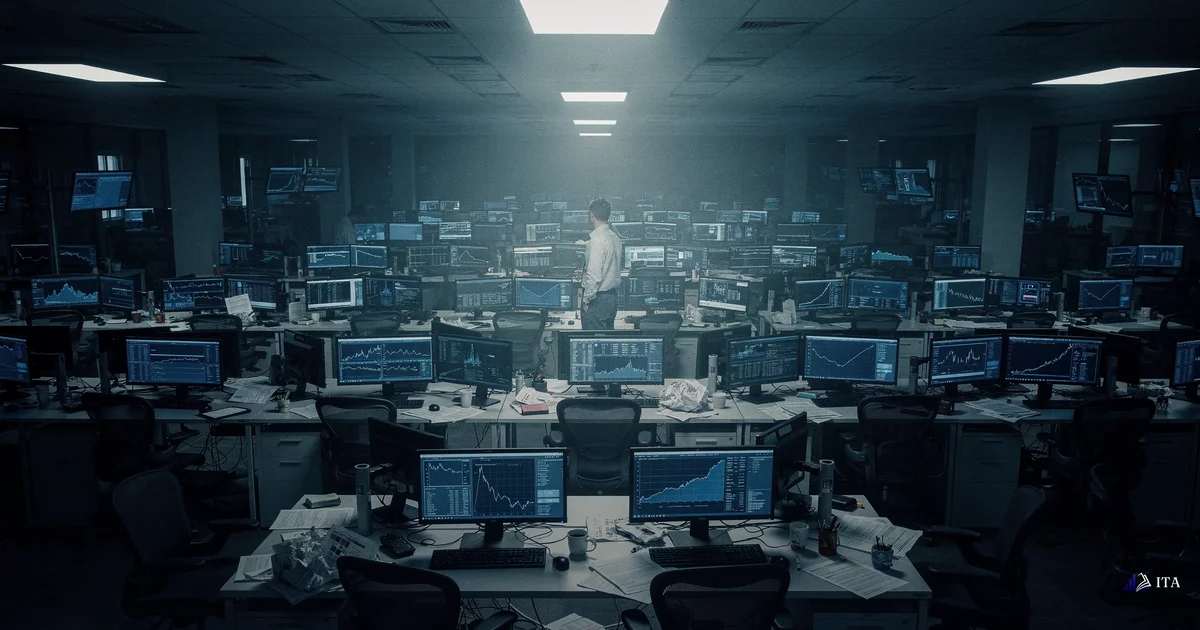

The Hidden Battleground: Why Psychology is Your Edge in Funded Trading
A price swings against your open position. Your pulse jumps, your palms go damp, and for a moment the plan you wrote that morning is nowhere in your head. That reaction is not a personal weakness. Research on trader physiology during live sessions has found something that surprises most people: professional traders tend to show physical stress responses, like elevated heart rate, that look strikingly similar to those of beginners. What separated the ones who kept their accounts from the ones who blew them was not a calmer nervous system. It was what happened in the next few seconds.
That single finding reframes the whole subject of funded trading. Accounts rarely get lost because a trader lacks a strategy or misreads a chart. They get lost in the narrow gap between a valid setup and the moment fear or greed quietly substitutes a different decision for the one already on paper.
This is what separates traders who keep their funded accounts from those who lose them within the first month. The sections below map that gap in order: the biases that distort judgment before a trade is even placed, the frameworks that remove the need for willpower once a position is open, and the daily habits that make both of those things automatic instead of aspirational.
Unmasking Cognitive Biases: How Your Brain Sabotages Profits
The gap between traders who survive a funded evaluation and traders who blow it in the second week is rarely willpower. It is wiring.
Every brain carries a set of shortcuts that served a species avoiding predators and does very little for someone reading a price chart. Confirmation bias pulls attention toward whatever supports the position already open and away from the signal that contradicts it. Loss aversion makes a realised loss feel roughly twice as painful as an equivalent gain feels good, which is exactly the asymmetry that turns a disciplined stop into a widened one. The sunk cost pattern keeps capital sitting in a fading trade, because closing it feels like admitting the original decision was wrong. Anchoring locks attention on the first price seen on the chart, making it harder to update the read as the market moves on without you.
None of that is a character flaw. It is sequencing. The signal that a trade has moved against you reaches the brain's threat detection circuitry well before it reaches the slower, reasoning part of the brain that would normally check the plan. By the time a conscious, rational read of the situation arrives, an emotional verdict has usually already been reached. That is why telling yourself to "just stay objective" in the middle of a losing trade rarely works: the objective read shows up late to a decision that has, in effect, already been made.
Building Ironclad Discipline: Practical Frameworks for Funded Traders
Most funded traders respond to that wiring problem by trying to out-will it. They write a rule, break it under pressure, write a stricter version of the same rule, and break that one too. Fighting biology with willpower is a losing bet: in the exact moment it matters most, biology has the faster circuit.
The traders who actually keep funded accounts take a different route: they move the decision earlier. Psychologists who study goal pursuit outside of trading call this an implementation intention, essentially an "if this happens, then I do that" rule set in advance, while calm, so there is nothing left to negotiate once the market gets loud. The decision has already been made. All that is left is execution.
A pre-trade checklist built on this logic is not paperwork. Each line is a circuit breaker that interrupts an emotional decision before it can complete itself.
Core framework elements:
- Risk parameters fixed before the session opens (position size is never calculated in the middle of a losing streak)
- Entry criteria written down in advance (a setup is either valid or it is not, with no discretionary call made mid-trade)
- Exit points mapped to price or time, not to feeling (removing the hesitation that turns a planned stop into a much larger one)
- A daily review that scores rule-following on its own line, separate from that day's profit and loss
This is what turns trading psychology from something fought every session into something configured once. Discipline stops depending on motivation and starts depending on a system built while the trader was calm enough to build it properly.

Mastering Emotional Control: Strategies for High-Pressure Environments
The pre-trade checklist handles the decision before a position is open. But it does not, by itself, help with the thirty seconds after a trade moves against you and adrenaline is already firing. That moment needs its own sequence, one short enough to run under pressure without thinking about it.
A workable version looks like this:
- Interrupt physically. Stand up, step back from the screen, unclench your hands. This is not relaxation for its own sake, it simply buys the few seconds the slower, reasoning part of the brain needs to catch up with the faster alarm circuit that fired first.
- Name what you are feeling. Say it out loud or write it down: the urge to close early, the urge to average down. Labelling an emotion measurably quiets the circuit driving it, a finding well established in affective neuroscience.
- Check the plan, not the feeling. Ask literally what the written rule says about this exact situation. If there is no rule for it, the default is no action until one exists.
- Execute the rule, then log it. Write down what triggered the emotion and which rule you followed. This is what turns a single interruption into a pattern the trader's process gets better at catching next time.
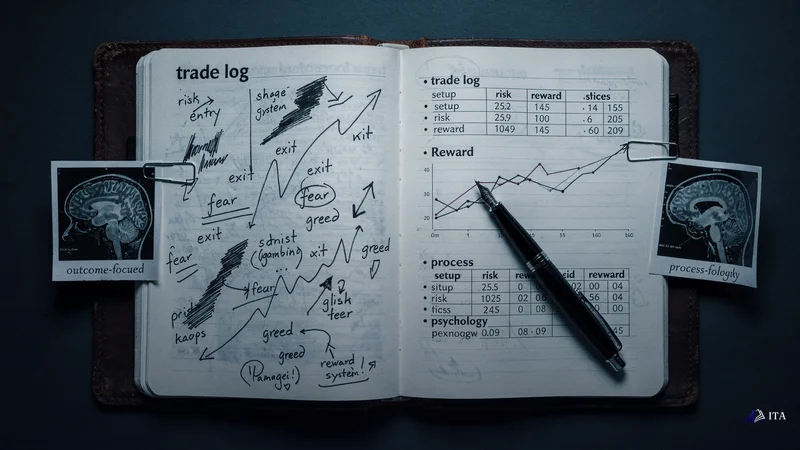
Post-trade review follows the same logic in reverse. Instead of judging trades as good or bad by outcome, evaluate the process: did the trade follow the checklist, and was the exit executed as written? A losing trade that followed the plan to the letter counts as a success in the journal. A winning trade that broke a rule gets flagged, because the rule breaking is what will eventually cost far more than that single win was worth.

The Funded Trader Mindset: Shifting from Gambler to Professional
This shift is not a matter of attitude. It is rewiring what the brain's reward system treats as a win: consistency of process, not the result of any single trade.
The trading journal becomes a psychological record rather than a diary of wins and losses. Each entry captures a decision-making pattern: what was the thinking behind the entry, what emotion showed up when price moved against it, what would change next time. Over months, patterns emerge that reveal a trader's specific psychological fingerprint, the two or three triggers that account for most of the rule breaks.
The real breakthrough usually comes from treating physical state as part of the plan, not separate from it. The amygdala's alarm response does not fire in isolation, it is measurably louder on a night of poor sleep or during a stretch of fatigue, and a tired brain has a smaller margin for the kind of regulation this whole framework depends on. Professional funded traders treat under-recovery as a risk factor with the same seriousness as a widened spread: they cut size, shorten the session, or sit it out entirely rather than run a full-size plan on a bad night's sleep.
Cultivating Psychological Resilience: Bouncing Back from Losses
Traders who hold up over a full evaluation cycle do not suppress fear, frustration, or the fear of missing a move. They redirect the energy those emotions carry into something the process can use: fear of missing out becomes an argument for better preparation before the session, not a reason to chase a trade mid-move. The discomfort of holding an open position becomes a reason to check the plan again, not a reason to close early.
Drawdowns are the sharpest test of that redirection. Facing a string of losses, the untrained inner monologue turns toxic fast: I am failing, I will never get this account funded, maybe this is not for me. The trained response is scripted instead: this is inside my normal variance, my edge plays out over a large sample of trades, what does this stretch of losses tell me about my process rather than about my worth as a trader. For the full framework on this exact pattern, see FOMO Trading.

The Neuroscience of Consistency: How to Rewire Your Brain for Profit
What separates consistent traders from streaky ones is not optimism. It is having a pre-built response ready for each predictable psychological state before that state shows up.
This is where the neuroscience meets the practical side of the job. Every repeated decision strengthens a specific neural pathway. Repeat a response enough times and it becomes what neuroscientists call procedural memory, an automatic sequence the brain runs without deliberate thought. Professional athletes do not consciously think through their technique mid-competition, because deliberate practice has already drilled that technique into the nervous system long before the event.
Trading responds to the same mechanism, and it can be trained even away from a live chart. Mentally rehearsing a specific scenario, a fast move against an open position, a missed entry on a clean setup, a string of wins that tempts oversized risk, engages much of the same circuitry as living through it, because the brain does not fully distinguish a vividly rehearsed sequence from an executed one. A few minutes of this kind of rehearsal before the session, repeated daily for a few weeks, is usually what separates a trader who has a rule on paper from a trader whose rule actually holds under pressure.

ITAfx's Approach to Trader Psychology: Discipline Meets Capital
At Institutional Trading Academy, this pattern shows up consistently across the funded traders we work with. The ones who progress toward larger funded accounts tend to follow the same arc: they stop trying to be disciplined in the moment and start building systems that make discipline the path of least resistance.
Our approach focuses on that architecture rather than on market analysis alone. We work with traders to write their own if-then rules for the scenarios that trip them up most often, rehearse those rules until they run automatically, and treat physical readiness, sleep, fatigue, mental load, as a genuine input into position sizing rather than an afterthought. The goal is never to eliminate emotion. It is to make sure emotion no longer decides the trade.
The funded traders who withdraw consistent payouts are not unusually calm people. They have simply stopped treating their own psychology as an obstacle to fight and started treating it as a system to design.
Conclusion: Your Mind is Your Ultimate Trading Asset
Your trading psychology for funded accounts is not one more skill sitting alongside strategy and risk management. It is the layer that determines whether either of those actually holds up once real capital, even simulated capital with a payout on the line, is at stake.
The pattern across this article is consistent: many funded traders struggle early on not from a lack of market knowledge, but because they never built systems that work with the brain's wiring instead of against it. The traders who last are not the ones with unusually strong willpower. They are the ones who moved their hardest decisions earlier, to a moment when they were calm enough to make them well.
Every bias covered here, every emotional trigger, every moment of doubt during a drawdown, is a predictable pattern, not a personal failing. Each one can be addressed through preparation, a written process, and the kind of mental discipline that does not depend on how anyone feels on a given morning.
The pre-trade checklist removes decision fatigue. The in-the-moment circuit breaker handles the thirty seconds that used to end accounts. The post-trade review turns losses into usable data instead of just a number. The psychological resilience habits make sure one difficult week does not cascade into a blown evaluation. None of this is theoretical, it is the operational backbone behind every trader who has kept a funded account across multiple payout cycles.
Physical state, biases, in-the-moment protocol, and drawdown resilience are not four separate topics. They are one system, and the trader who builds all four pieces is the one whose plan actually survives contact with a live market. Our guide on Margin Requirements Prop Firm Accounts covers how that same discipline extends into position sizing and account rules.
Ready to put institutional psychology to work? Apply for your funded account and discover how discipline meets capital at ITAfx.
Ready to get funded?
50% off instant accounts with code 50CRYPTO.
Get Funded →Frequently Asked Questions
What role does psychology play in funded trading failure?
Many funded traders fail early on primarily due to psychological factors rather than lack of market knowledge or strategy. The issue isn't technical incompetence but the inability to architect systems that work with human psychology rather than against it.
How do successful traders handle cognitive biases in trading?
Consistently successful traders don't fight cognitive biases through willpower. Instead, they design systems that make emotions irrelevant to trading decisions. They use pre-trade checklists as cognitive architecture and post-trade analysis that evaluates process over outcomes.
What is emotional aikido in trading psychology?
Emotional aikido is a technique where traders redirect emotional energy rather than suppress it. Fear of missing out becomes fuel for rigorous preparation, position anxiety transforms into systematic monitoring, and anger from losses channels into deeper market analysis.
How can traders build discipline without relying on willpower?
Professional traders create automated decision-making through systematic repetition and procedural memory. They use pre-programmed responses to predictable psychological states, making disciplined choices automatic rather than conscious efforts that drain mental energy and fail under pressure.
What role does neuroscience play in consistent trading performance?
Neuroscience shows that repeated behaviours create neural pathways that become automatic procedural memory. Successful traders drill their decision-making frameworks until their brains literally rewire to make disciplined choices without conscious effort, similar to professional athletes automating technique.
Key Takeaways
- Use pre-trade checklists as cognitive architecture: each item is an implementation intention that interrupts emotional decision-making before it can complete itself.
- Run a four-step circuit breaker the moment a trade moves against you: interrupt physically, name the emotion, check the written rule, then execute and log it.
- Evaluate trades on process adherence, not outcomes: a losing trade that followed the plan counts as a success in your journal.
- Treat sleep and fatigue as a risk input, not an afterthought: a tired brain has a smaller margin for emotional regulation, so cut size on a bad night's recovery.
- Build procedural memory through deliberate rehearsal: mentally walk through high-pressure scenarios daily until the response runs without conscious effort.
- Design psychological frameworks for predictable states: pre-program responses to drawdowns before they trigger toxic self-talk patterns.
Start Your Trading Evaluation
Simulated funded accounts up to $400K. Up to 95% profit split.
Get Funded